
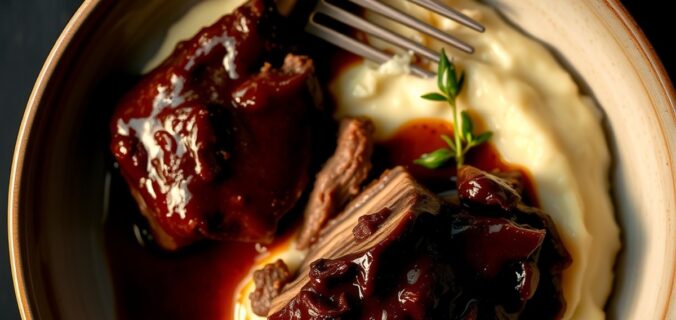
The photo above was generated using AI. Made this and have a real photo? We’d love to feature it — submit yours here.
Beef cheeks are one of the best-value cuts in the butcher’s cabinet and one of the least bought, mostly because people don’t know what to do with them. Cooked for twenty minutes they are inedible. Cooked for three hours they turn into something close to the richest braise you can make at home.
Serves 4, about 3 1/2 hours, nearly all of it in the oven.
What a beef cheek actually is
The cheek is the muscle a cow chews with, and a cow chews for around eight hours a day for its whole life. It’s the hardest-working muscle on the animal.
That means two things. It’s very tough, and it’s absolutely loaded with collagen — the connective tissue that binds hard-working muscle together. Collagen is what makes the cut impossible to cook quickly, and it’s also exactly why it’s worth cooking slowly: held above about 70°C for a couple of hours, collagen breaks down into gelatine.
Gelatine is what gives a great braise its silky, lip-sticking, glossy quality. You cannot get that texture from a lean cut, no matter how good it is. It’s the reason cheeks beat scotch fillet in a stew.
Trim the silverskin — this is the step recipes skip
Each cheek has a tough, pearly, slightly iridescent membrane running across one side. That’s silverskin, and unlike collagen it does not break down. Three hours in the oven and it will still be there as a chewy sheet through an otherwise perfect piece of meat.
Slide a sharp knife under one edge, angle the blade slightly upward, and pull the membrane taut as you cut along it. It comes away in strips. Two minutes a cheek, and it’s the difference between very good and slightly disappointing.
Some butchers trim them. Most don’t. Check.
Three hours, and check for collapse not time
Cheeks are done when a fork slides in and twists with no resistance at all, and the meat gives way rather than holding together. That is usually around three hours at 150°C, but cheeks vary a lot in size.
Undercooked is the usual failure. At two and a half hours they’re often still faintly springy, and the temptation is to call it. Give them another half hour — you genuinely cannot overcook them by the low-and-slow method, they just get softer.
Reduce the sauce at the end
Same as the lamb shanks: lift the cheeks out and boil the braising liquid down by about half until it’s glossy and coats a spoon.
With cheeks this matters even more, because all that dissolved gelatine means the reduced sauce sets to a genuine shine. It’s the best sauce you’ll get from any cut of beef.
Better the next day
The gelatine that makes the sauce good also means the whole thing sets almost solid in the fridge and reheats beautifully. Cook it the day before if you can, then lift off any set fat and reheat gently. The flavour deepens noticeably overnight.
Frequently asked questions
What are beef cheeks?
The cheek muscle — the hardest-working muscle on the animal, and consequently full of collagen. Slow cooking turns that collagen into gelatine, which is what gives the finished dish its silky texture and glossy sauce.
How long do beef cheeks take to cook?
About 3 hours at 150°C. Judge by feel, not the clock: a fork should slide in and twist with no resistance at all. Undercooking is the usual mistake — they can take 3 1/2 hours.
Do I need to trim beef cheeks?
Yes, and most recipes don’t mention it. Each cheek has a tough silvery membrane that never breaks down no matter how long you cook it. Cut it away with a sharp knife before browning.
Can you overcook beef cheeks?
Not really, by the low-and-slow method. They just keep getting softer. Cooking them too hot or too fast is what ruins them.
Where do I buy beef cheeks in NZ?
Most butchers will have them or can order them, and supermarkets increasingly stock them. They’re one of the cheapest cuts on the counter.
Can I cook beef cheeks in a slow cooker?
Yes — brown them first, then 8 hours on low. Reduce the sauce on the stove afterwards, since nothing evaporates in a slow cooker.
Why is my sauce thin?
It wasn’t reduced. Lift the meat out and boil the liquid hard for 10 minutes. The dissolved gelatine means it thickens and goes glossy as it reduces.
Can I make them ahead?
Yes, and they’re better for it. Cook a day ahead, refrigerate, lift off the set fat, and reheat gently. The flavour deepens overnight.
What can I use instead of red wine?
An extra cup of beef stock plus 2 Tbsp balsamic vinegar. You need acidity from somewhere against the richness.
Variations
- Asian braise — soy, star anise, ginger and Shaoxing wine instead of the red wine and herbs. Serve with rice.
- Ragu — shred the cooked cheeks through the reduced sauce and serve over pappardelle. Arguably the best use of them.
- Mushroom — 300 g mushrooms browned separately and added for the last half hour.
- Beer — a bottle of dark ale in place of the wine.
- Pressure cooker — 50 minutes at high pressure, then reduce the sauce as usual.
| Prep Time | 25 minutes |
| Cook Time | 3 hours |
| Servings |
servings
|
- 4 beef cheeks trimmed of silverskin, about 1.2 kg total
- 2 Tbsp plain flour
- 2 Tbsp oil
- 1 onion diced
- 2 carrots chunked
- 2 sticks celery sliced
- 4 cloves garlic crushed
- 2 Tbsp tomato paste
- 2 cups dry red wine 500 ml
- 2 cups beef stock 500 ml
- 3 sprigs thyme
- 2 bay leaves
- 1 tsp brown sugar
- salt and freshly ground black pepper
- mashed potato to serve
Ingredients
|
|
- Heat the oven to 150°C (130°C fan).
- **Trim the cheeks.** Slide a sharp knife under the tough pearly membrane on one side of each cheek, angle the blade slightly up, pull the membrane taut and cut it away in strips. Discard it.
- Pat the cheeks dry, season generously, and dust all over with the flour.
- Heat the oil in a heavy casserole over a high heat and brown the cheeks hard on both sides, about 4 minutes a side, in two batches. Set aside.
- Turn the heat down to medium. Cook the onion, carrot and celery for 8 minutes, then add the garlic for a minute and the tomato paste for another.
- Pour in the red wine and let it bubble hard for 3 minutes, scraping the base of the pan clean.
- Return the cheeks, add the stock, thyme, bay leaves and sugar. The liquid should come about three-quarters of the way up the meat. Bring to a simmer.
- Cover and transfer to the oven for **3 hours**. Check at 2 1/2 — a fork should slide in and twist with no resistance whatsoever. If there's any spring left, give it another 30 minutes.
- Lift the cheeks out carefully and keep warm. Strain the liquid into a saucepan and boil hard for 10 minutes until reduced by about half and glossy enough to coat a spoon.
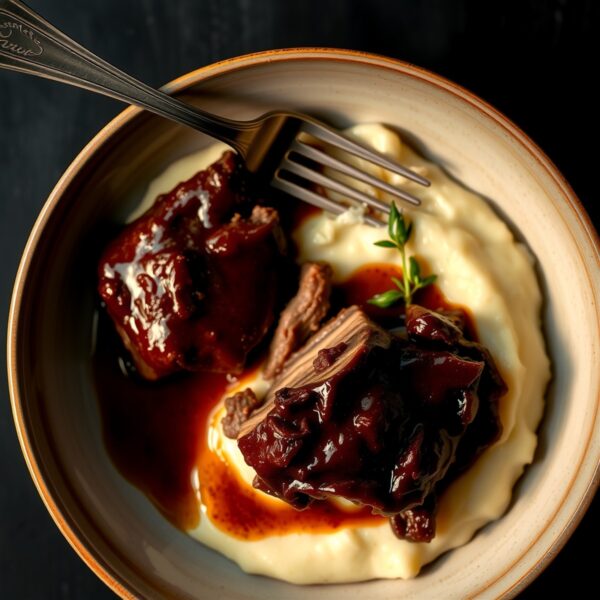
- Season the sauce, return the cheeks to warm through, and serve over mashed potato with the sauce spooned over.