
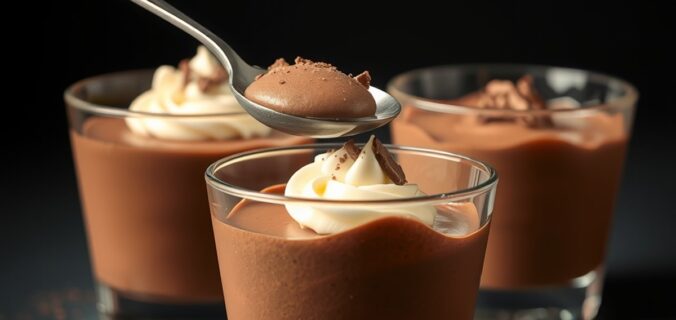
The photo above was generated using AI. Made this and have a real photo? We’d love to feature it — submit yours here.
Chocolate mousse is four ingredients and twenty minutes, and it fails in one dramatic way that puts people off trying again: the chocolate seizes into grainy lumps the moment the cream goes in.
That’s a temperature problem with a simple fix.
Serves 6. Twenty minutes of work, then it needs four hours in the fridge.
The temperature problem, and the fix
Melted chocolate is around 45°C. Whipped cream out of the fridge is around 5°C. Put one into the other and the cocoa butter in the chocolate solidifies instantly on contact with the cold, and you get hard grainy specks through your mousse that will not smooth out.
The fix is to close the gap. Let the melted chocolate cool until it’s only just warm — about 30°C, barely warmer than your finger — and take the cream out of the fridge fifteen minutes before you whip it.
Then temper it: fold a third of the cream into the chocolate first and beat it in properly, not gently. That first third will lose some air, and that’s fine — its job is to loosen the chocolate to a foldable consistency. Only then fold the remaining two thirds in gently.
That order is the whole technique. Fold cold cream straight into warm chocolate and it seizes every time.
Don’t let water near the chocolate
A few drops of water will make melted chocolate seize into a stiff paste. Steam counts as water.
Melt it in a bowl over barely simmering water with the bowl not touching, and wipe the base of the bowl before it goes near anything. Or use 30-second bursts in the microwave at half power, stirring between each — genuinely easier and less risky.
Every bowl, spatula and whisk must be completely dry.
Whip the cream to soft peaks, not stiff
Soft peaks means the cream just holds a shape and the peak flops over when you lift the whisk.
Stiff peaks are already halfway to butter, and over-whipped cream won’t fold — it breaks into lumps and gives a grainy mousse with a slightly greasy mouthfeel. Under-whipped is more recoverable than over-whipped, so stop early and check.
Egg whites make it lighter, and there’s a raw egg question
The lightest chocolate mousse uses whisked egg whites folded in as well as cream. It’s noticeably airier.
It also means raw egg white, which is a genuine consideration for pregnant women, young children, the elderly and anyone immunocompromised. New Zealand eggs are low risk, but low risk isn’t no risk.
This recipe is cream-only, so there’s no raw egg in it at all. It’s slightly denser than an egg-white version and completely fine for everyone. The egg white variation is at the end if you want it, with the caveat attached.
Good chocolate matters here more than usual
There are four ingredients and one of them is chocolate, so there’s nowhere for a cheap one to hide.
Use a dark chocolate at 55–70% cocoa. Below 50% and the mousse is sweet and slack; above 75% it can set slightly chalky and bitter. Compound or “chocolate flavoured” baking chocolate uses vegetable fat rather than cocoa butter and sets waxy — it’s the one substitution that genuinely doesn’t work.
Frequently asked questions
Why did my chocolate mousse go grainy?
Cold cream hit warm chocolate and the cocoa butter seized. Let the melted chocolate cool to barely warm, take the cream out of the fridge first, and beat a third of the cream in firmly before folding the rest through gently.
Why did my melted chocolate turn into a stiff paste?
Water got into it. Even a few drops, or steam from the pan below, will make chocolate seize. Every bowl and utensil must be bone dry.
Does chocolate mousse have raw egg in it?
This version doesn’t — it’s cream only. The lightest mousses use whisked raw egg white, which is a consideration for pregnant women, young children and anyone immunocompromised. The egg-white version is in the variations with that caveat.
Do I need gelatine?
No. The mousse sets from the cocoa butter in the chocolate firming up as it chills. Gelatine makes it more of a set dessert and less of a mousse.
What chocolate should I use?
Dark chocolate between 55% and 70%. Below 50% it’s too sweet and slack; above 75% it can set chalky. Avoid compound or “chocolate flavoured” baking chocolate — it uses vegetable fat and sets waxy.
How long does it need to set?
Four hours minimum, overnight ideally. It’s not fully set before that.
How long does it keep?
Three days covered in the fridge. It doesn’t freeze well — it goes grainy on thawing.
Can I make it dairy free?
Yes. Chill a can of full-fat coconut cream overnight, whip the solid part, and use dark chocolate that contains no milk solids. The result is slightly firmer and tastes faintly of coconut.
Why is my mousse dense rather than light?
The cream was over-whipped, or it was overmixed when folding. Soft peaks, and stop folding the moment there are no white streaks.
Variations
- Classic (with egg white) — whisk 3 egg whites to soft peaks and fold them in after the cream. Noticeably lighter. Contains raw egg — not for pregnant women, young children, the elderly or anyone immunocompromised.
- Orange — the zest of an orange melted with the chocolate, and 1 Tbsp Cointreau.
- Salted caramel — a swirl of caramel sauce through each glass and flaky salt on top.
- White chocolate and raspberry — white chocolate (which needs even gentler melting) with fresh raspberries folded through.
- Mocha — 2 tsp instant espresso powder dissolved in a teaspoon of hot water, added to the melted chocolate.
| Prep Time | 20 minutes |
| Cook Time | 0 minutes |
| Servings |
servings
|
- 200 g dark chocolate chopped, 55-70%
- 1 1/2 cups Cream 375 ml
- 2 Tbsp caster sugar
- 1 tsp vanilla extract
- pinch salt
- Cream extra, to serve
- grated chocolate to serve
Ingredients
|
|
- Take the cream out of the fridge 15 minutes before you start.
- Melt the chocolate in a dry heatproof bowl over a pan of barely simmering water, the bowl not touching the water. Stir until smooth, then **take it off and let it cool until only just warm** — barely warmer than your finger. This takes about 10 minutes.
- Whip the cream with the sugar, vanilla and salt to **soft peaks** — it should just hold a shape and flop over when you lift the whisk. Don't take it further.
- Add **a third of the cream** to the cooled chocolate and beat it in firmly until completely smooth and loosened. Don't be gentle with this part.
- Fold the remaining cream through in two additions, **gently now**, until just combined with no white streaks. Stop as soon as it's uniform.
- Spoon into six glasses or ramekins and refrigerate for at least 4 hours, or overnight.
- Serve with a spoonful of softly whipped cream and grated chocolate.