
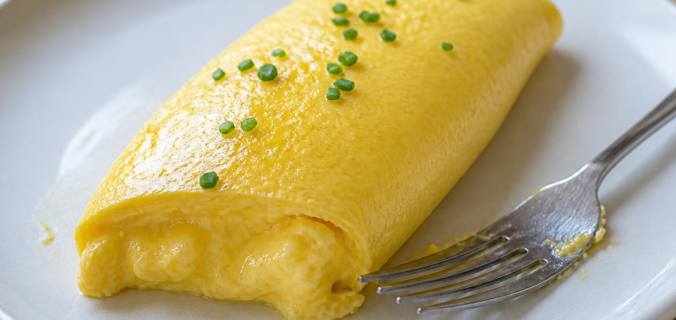
The photo above was generated using AI. Made this and have a real photo? We’d love to feature it — submit yours here.
An omelette takes three minutes and three eggs and there is nowhere to hide. It’s the dish chefs are traditionally asked to cook at a job interview, because everything you’d want to know about someone’s technique shows up in it.
The good news: it’s four rules, and none of them is hard.
Serves 1. Make them one at a time.
Three eggs, one at a time
An omelette works because a thin layer of egg cooks fast and evenly. Load the pan with five or six eggs and the base overcooks long before the top has set — you can’t win it.
Three eggs in a 20 cm pan is the ratio. Two eggs in an 18 cm pan also works. If you’re feeding four people, make four omelettes, one after the other. Each takes three minutes and the fourth is as good as the first.
The pan has to be non-stick and the right size
A 20 cm non-stick pan. Not a big frying pan, not stainless steel unless you’re very confident.
Too large a pan spreads three eggs thin and they overcook before you can fold. Too small and the omelette is thick and undercooked in the middle. The pan does half the work here and it’s worth having the right one.
Medium-low heat, and keep it moving
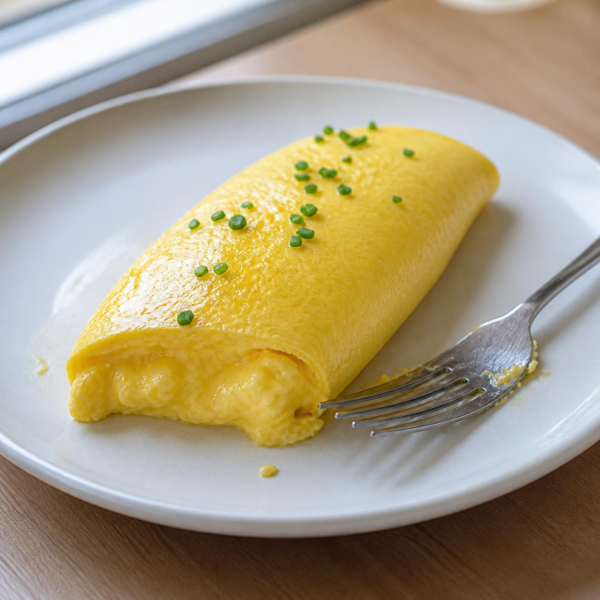
A French omelette should have no colour on it at all — pale yellow, soft, almost silky. Brown patches mean the pan was too hot.
For the first 30 seconds, stir the eggs constantly with a spatula, pulling the setting curds in from the edges and letting the liquid run underneath. You’re making small soft curds, not one flat sheet.
Then stop stirring, let the base set for another 20 seconds, and fold.
An American-style diner omelette — set flat, browned a little, folded over a filling — is a legitimately different dish and plenty of people prefer it. If that’s what you’re after, medium heat and no stirring.
Take it out underdone
The omelette keeps cooking on the plate. Slide it out while the centre still looks slightly wet and glossy — what the French call baveuse — and by the time it reaches the table it will be perfectly set.
An omelette that looks done in the pan is overdone on the plate. This is the single most common mistake and it’s the difference between soft and rubbery.
Go easy on the filling
Two tablespoons. That’s it.
Overfilled omelettes tear when you fold them, and the filling cools the egg so the outside toughens while you wait for the middle. Cheese should be grated fine so it melts in the residual heat. Anything raw — mushrooms, onion, capsicum — must be cooked first and cooled slightly, because a wet filling makes a wet omelette.
Frequently asked questions
How many eggs in an omelette?
Three, in a 20 cm pan. More than that and the base overcooks before the top sets. To feed several people, make them one at a time.
Should you add milk to an omelette?
It’s optional and it does very little. A tablespoon makes it marginally softer; more than that dilutes the egg and makes it watery. Water does the same job as milk. Plenty of good cooks use neither.
Why is my omelette rubbery?
It was cooked too long or too hot. Take it out of the pan while the middle still looks slightly wet — it finishes cooking from residual heat on the plate.
Why is my omelette brown?
The pan was too hot. A French omelette should have no colour at all. Medium-low heat, and butter that foams without browning.
What pan should I use?
A 20 cm non-stick. The size matters as much as the surface — too big and three eggs spread too thin, too small and the omelette is thick and undercooked.
Can I make an omelette without butter?
Oil works but you lose flavour, and butter’s foaming is a useful temperature gauge. If the butter browns immediately, the pan is too hot.
Why does my omelette tear when I fold it?
Usually too much filling, or the base wasn’t set enough before folding. Two tablespoons of filling is plenty, and give the base 20 seconds undisturbed before you fold.
What’s the difference between a French and an American omelette?
A French omelette is stirred, pale, soft and folded in three. An American one is left to set flat, takes a little colour, and is folded in half over a fuller filling. Both are legitimate; they’re just different dishes.
Variations
- Cheese and herb — grated tasty cheese and chopped chives or parsley.
- Mushroom — 100 g mushrooms sautéed until browned and any liquid cooked off, then cooled slightly.
- Ham and cheese — the standard, and hard to beat.
- Spanish-style (tortilla) — a different dish entirely: sliced potato and onion cooked slowly in oil, then set in the egg over low heat and finished under a grill.
- Plain — no filling at all, just butter, salt and pepper. Arguably the best test of whether you’ve got the technique.
| Prep Time | 2 minutes |
| Cook Time | 3 minutes |
| Servings |
servings
|
- 3 eggs
- 1 Tbsp milk or water optional
- pinch salt
- freshly ground black pepper
- 15 g butter
- 2 Tbsp Filling your choice of grated cheese, chopped ham, cooked mushrooms or herbs
Ingredients
|
|
- Crack the eggs into a bowl, add the salt, pepper and the milk if using, and beat with a fork just until the yolks and whites are combined. Don't whisk air into them.
- Heat a 20 cm non-stick pan over a medium-low heat and add the butter. Let it foam but not colour.
- Pour in the eggs. For the first 30 seconds, stir continuously with a spatula, pulling the set edges into the centre and tilting the pan so the liquid runs into the gaps.
- When it looks like soft curds with a little liquid still on top, stop stirring. Let it sit for 20 seconds so the base sets.
- Scatter the filling over one half only.
- Tilt the pan away from you and fold the empty half over the filling with the spatula. Let it sit for 10 seconds.
- Slide it onto a warm plate — **while the centre still looks slightly glossy.** It finishes cooking on the plate.