
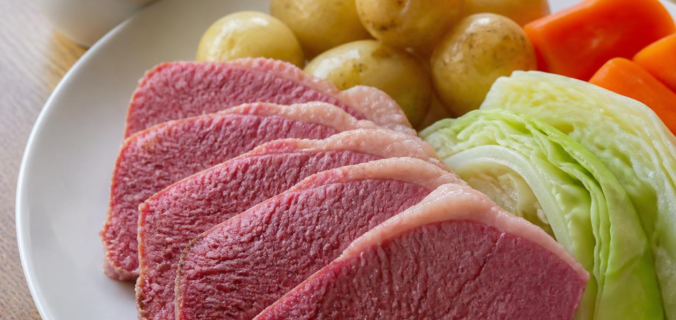
The photo above was generated using AI. Made this and have a real photo? We’d love to feature it — submit yours here.
Corned beef is a Sunday dinner that mostly cooks itself, feeds six for under twenty dollars, and makes better sandwiches on Monday than it did as a dinner on Sunday. It also has a reputation for being dry and salty, which is entirely avoidable and comes down to one mistake.
This serves 6, takes about 3 hours on the stove, or 8 hours in a slow cooker.
Corned beef and silverside are the same thing
Worth clearing up, because half the country uses one word and half uses the other.
Silverside is the cut — a lean piece from the outside of the hind leg, named for the silvery sheet of connective tissue running along one side. Corning is the preservation method: curing the meat in a salt brine, historically with “corns” of rock salt, which is where the name comes from and why there’s no corn in it.
So a New Zealand corned beef is corned silverside. You’ll occasionally see corned brisket, which is fattier and richer and takes longer, but silverside is what’s in the supermarket chiller.
The mistake that makes it dry and salty
Boiling it.
A hard boil at 100°C tightens the muscle fibres and squeezes moisture out, and because the meat is already salted, what you’re left with is dry and concentrated. Corned beef should never boil. Bring it up to temperature, then drop the heat until the surface is barely moving — an occasional lazy bubble, no more. It’ll take three hours at that pace and come out sliceable and moist.
The second half of the fix is to let it cool in its own liquid. Lifting a hot corned beef straight out onto a board loses you a surprising amount of moisture in the first ten minutes. Turn the heat off and leave it in the pot for 20 minutes before slicing.
Vinegar and brown sugar
The malt vinegar and brown sugar in the pot aren’t a flavouring so much as a correction. The vinegar cuts the salt and tenderises slightly; the sugar balances the vinegar. This is the classic New Zealand treatment and it’s why a Kiwi corned beef tastes different to an American one, which typically goes in with just pickling spice.
A tablespoon of golden syrup instead of the sugar is common in older recipes and gives a rounder, slightly malty result.
Slice it across the grain
Silverside is lean and the muscle fibres run the length of the piece. Slice with the grain and it’s stringy no matter how well you cooked it. Look at the direction of the fibres on the cut end and slice at right angles to them, as thinly as you can manage.
Frequently asked questions
What is the difference between corned beef and silverside?
None, in New Zealand. Silverside is the cut of beef; corning is the salt-curing process. Corned silverside is what most people mean by either word. Corned brisket also exists — fattier, richer, and it needs longer.
Why is my corned beef tough and dry?
It boiled. A hard boil squeezes moisture out of already-salted meat. Keep the water at a bare simmer where the surface barely moves, and let the beef cool in its liquid for 20 minutes before slicing.
Do I need to soak corned beef before cooking?
Not usually — a rinse under cold water is enough for supermarket silverside. If yours is from a butcher and particularly heavily cured, an hour in cold water will take the edge off.
Why put vinegar and sugar in the water?
The malt vinegar cuts the saltiness and helps tenderise; the brown sugar balances the vinegar. It’s the standard New Zealand treatment and it’s why a Kiwi corned beef tastes different to an American one.
Can I cook corned beef in a slow cooker?
Yes, and it’s arguably the better method. Low for 8 hours, covered with water, with the same aromatics. The gentle heat makes it very hard to overcook.
How do I slice it?
Thinly, and across the grain. Look at the fibres on the cut end and slice at right angles to them. Slicing along the grain makes even a perfectly cooked piece stringy.
How long does it keep, and can I freeze it?
Five days in the fridge, stored in a little of its cooking liquid so it doesn’t dry out. It freezes for three months, sliced, though the texture softens slightly.
What do I do with the leftovers?
Corned beef fritters, corned beef hash, or sandwiches with mustard and pickle. Most Kiwi households would say the leftovers are the point.
Variations
- Golden syrup — 1 tablespoon instead of the brown sugar, for a rounder, maltier result.
- Beer — replace 2 cups of the water with a bottle of dark ale.
- Glazed — after simmering, pat dry, coat in a mix of 2 Tbsp brown sugar and 1 Tbsp mustard, and roast at 200°C for 20 minutes.
- Parsley sauce instead of mustard — same white sauce base with a large handful of chopped parsley.
| Prep Time | 10 minutes |
| Cook Time | 3 hours |
| Servings |
servings
|
- 1.5 kg corned silverside
- 2 Tbsp brown sugar
- 2 Tbsp malt vinegar
- 1 onion peeled and quartered
- 2 carrots roughly chopped
- 2 bay leaves
- 6 whole peppercorns
- 4 whole cloves
- 50 g butter
- 1/4 cup plain flour 35 g
- 2 cups milk 500 ml
- 2 Tbsp wholegrain mustard
- 1 Tbsp cooking liquid
- salt and pepper
Ingredients
For the beef
Mustard sauce
|
|
- Rinse the silverside under cold water to remove the surface brine and sit it in a large pot.
- Add the brown sugar, malt vinegar, onion, carrot, bay leaves, peppercorns and cloves. Cover with cold water by about 3 cm.
- Bring slowly to a simmer over a medium heat. As soon as it reaches a simmer, turn the heat right down. **The water must not boil** — you want the surface barely moving.
- Simmer gently, partly covered, for about 3 hours, or 50 minutes per 500 g. It's ready when a skewer slides into the thickest part with no resistance.
- Turn off the heat and leave the beef in its liquid for 20 minutes.
- Make the sauce while it rests. Melt the butter in a saucepan, stir in the flour and cook for a minute. Take it off the heat and add the milk a little at a time, whisking smooth after each addition. Return to the heat and stir until it thickens, about 5 minutes. Stir in the mustard and a tablespoon of the beef cooking liquid, and season.
- Lift the beef out, rest it for 5 minutes on a board, then slice thinly across the grain.
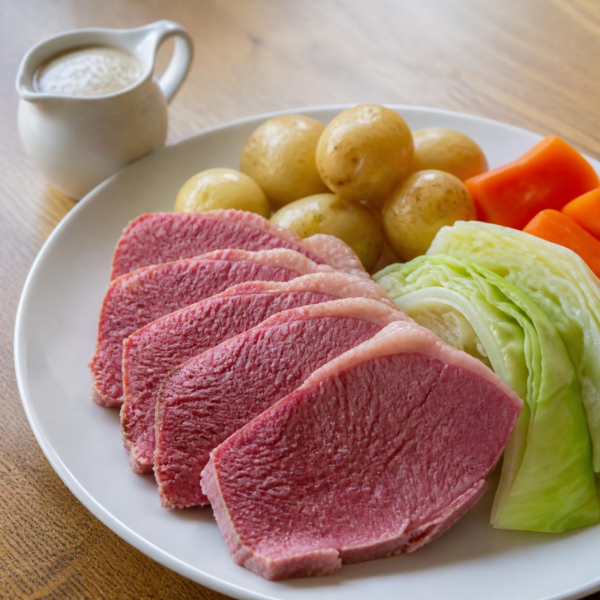
- Serve with the mustard sauce, boiled potatoes and buttered cabbage or silverbeet.