
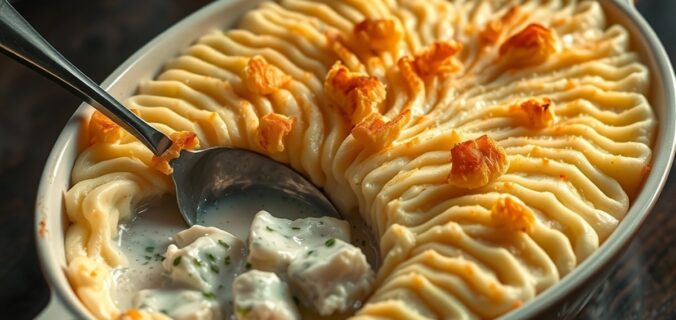
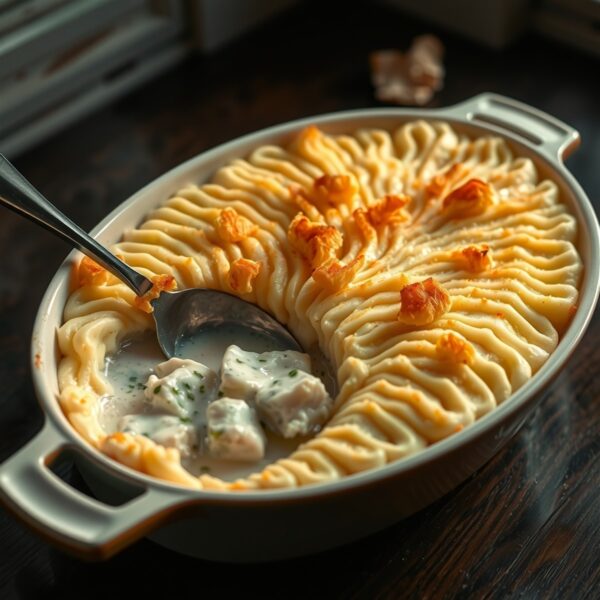
The photo above was generated using AI. Made this and have a real photo? We’d love to feature it — submit yours here.
Fish pie has a reputation for being bland and slightly sad, and when it is, the cause is nearly always the same: the fish was cooked twice. Poached first, then baked for another half hour under a lid of mash, by which point it’s chalky and it’s given up all its moisture into the sauce.
The fix is to not cook it the first time.
Serves 6, about an hour.
Put the fish in raw
The pie spends 30 minutes at 200°C. That is more than enough to cook a 3 cm cube of fish through — considerably more than enough.
So make the sauce, take it off the heat, and fold the raw fish through it. It poaches gently in the sauce as the pie bakes, it stays in distinct moist pieces, and the juices it releases go into the sauce rather than being poured down the sink.
This is the single change that separates a good fish pie from the version most people remember.
Which fish
New Zealand is well served here and you don’t need anything expensive.
Hoki is the value option — mild, holds together reasonably, and cheap. Terakihi and snapper are both excellent and firmer. Blue cod is a luxury and slightly wasted in a pie. Avoid anything very oily; salmon works in small quantity but takes over if you use much.
Frozen fish is fine and often better value, but thaw it fully and pat it very dry. Frozen fish carries a lot of water and it will thin your sauce.
Smoked fish is not optional, really
A pie made entirely from fresh white fish tastes mild to the point of vagueness. About a quarter of the total weight as smoked fish transforms it — it brings salt, smoke and depth that fresh fish can’t, and it’s what makes the pie taste like something rather than like fish in white sauce.
Smoked hoki or smoked kahawai both work. Don’t go beyond a third of the total or the smoke dominates.
The sauce has to be thicker than it looks right
The fish releases liquid as it bakes. A sauce that seems correctly thick when you make it will be noticeably loose in the finished pie.
Make it thicker than you want the end result — coating the back of a spoon heavily, closer to a thick custard than a pouring sauce. It will loosen. If you make it at pouring consistency you’ll get a fish soup with a mash lid.
Eggs and the mash lid
Hard-boiled eggs are traditional and divide people. They add substance and they’re worth including — quartered, tucked in among the fish, not chopped through.
The mash follows the same rules as the cottage pie: dry, stiff, spooned on around the edge first, and raked with a fork so the ridges crisp.
Frequently asked questions
Should I cook the fish before putting it in a fish pie?
No. Add it raw. The pie bakes for over 30 minutes, which is far more than enough to cook it through, and pre-cooking is why most fish pies end up dry and chalky.
What fish is best for fish pie in NZ?
Hoki for value, terakihi or snapper for a firmer texture. Add about a quarter of the total weight as smoked fish — smoked hoki or kahawai — which is what gives the pie its depth.
Do I have to use smoked fish?
Not strictly, but a pie made entirely from fresh white fish is noticeably bland. A quarter smoked is the proportion that works; a third is the most you’d want.
Why is my fish pie watery?
The sauce wasn’t thick enough, or the fish went in wet. The fish releases liquid as it bakes, so make the sauce thicker than seems right, and pat thawed frozen fish very dry.
Can I use frozen fish?
Yes, and it’s often better value. Thaw it completely and pat it dry with paper towels first — frozen fish holds a lot of water.
Can I make fish pie ahead?
Assemble it up to a day ahead and refrigerate, then bake from cold with an extra 10 minutes. It also freezes unbaked for two months; bake from frozen at 180°C for about an hour.
Do I have to put eggs in?
No, and people are divided on it. They add substance. Quarter them rather than chopping, and tuck them in whole among the fish.
Can I use pastry instead of mash?
Yes — a puff pastry lid over the same filling works well and is faster. Blind baking isn’t necessary since there’s no base.
Variations
- Prawn and fish — replace 200 g of the white fish with raw prawns, added raw with everything else.
- Cheesy leek — double the leek and stir 1/2 cup of grated cheese into the sauce.
- Kūmara top — half kūmara, half potato in the mash.
- Puff pastry lid — skip the mash entirely and lid it with puff pastry, egg-washed.
- Extra lemon — a squeeze of juice as well as the zest, stirred into the sauce. Suits the smoked fish.
| Prep Time | 25 minutes |
| Cook Time | 35 minutes |
| Servings |
servings
|
- 600 g firm white fish fillets skinned, cut into 3 cm pieces, hoki, terakihi or snapper
- 200 g smoked fish flaked, bones removed
- 3 eggs hard boiled and quartered
- 50 g butter
- 1 leek finely sliced
- 1/3 cup plain flour 50 g
- 2 cups milk 500 ml
- 1 tsp Dijon mustard
- 2 Tbsp chopped parsley
- 1 Tbsp chopped dill optional
- 1 Lemon zest only
- salt and freshly ground white pepper
- 1.2 kg floury potatoes peeled and cut into chunks, Agria or Ilam Hardy
- 60 g butter
- 1/3 cup milk warmed, 80 ml
- 1/2 cup grated tasty cheese 50 g
Ingredients
Filling
Mash
|
|
- Boil the potatoes in salted water for 15–18 minutes until tender. Drain and leave to steam dry in the colander for 2 minutes, then mash with the butter and just enough warm milk to make a stiff mash. Season well.
- Heat the oven to 200°C (180°C fan).
- Melt the butter in a saucepan over a medium heat and cook the leek for 6–8 minutes until soft but not coloured.
- Stir in the flour and cook for a minute. Take off the heat and add the milk a little at a time, whisking smooth after each addition. Return to the heat and stir until it thickens — keep going until it's **very** thick, heavily coating the back of a spoon. About 5 minutes.
- Take off the heat and stir in the mustard, parsley, dill and lemon zest. Season with salt and white pepper.
- Fold the **raw** white fish and the flaked smoked fish gently through the hot sauce. Don't cook it — the oven will do that.
- Tip into a 2.5 litre baking dish and tuck the quartered eggs in among the fish.
- Spoon the mash on in blobs around the outside edge first, then work inward and join them up. Rake the surface with a fork and scatter over the cheese.
- Bake for 30–35 minutes, until the top is golden and the sauce is bubbling at the edges.
- Stand for 10 minutes before serving.